
Editor’s Note: This guest post is from PoolGenius, a provider of data-driven tools that have helped subscribers win more than $10 million in sports pools since 2017.
If you’re playing in the VSiN High Stakes Masters Challenge on Splash Sports, this isn’t your typical Masters pool.
This is a capped-field contest with 223 entries, a $500 buy-in, and a $100,000 prize pool. First place alone takes home $20,000, with strong payouts throughout the top of the standings.
That changes the way you should think about your Masters pool picks.
You’re not just trying to put together a decent lineup. You’re building against a relatively small field, but one where a lot of entries are going to be well thought out.
So the goal isn’t just to be right. It’s to be right in a way that actually separates.
Embed from Getty ImagesHow the VSiN Masters Challenge Contest Works
Before getting into strategy, it’s worth walking through how this format for the VSiN High Stakes Masters Challenge actually plays out.
You’ll be selecting one golfer from each of six tiers.
- Six total golfers
- Only your best five scores count
- Your worst score gets dropped
Scoring is based on strokes relative to par:
- -1 point for every stroke under par
- 0 for par
- +1 point for every stroke over par
This isn’t a format where you’re only chasing finishing position. A golfer who grinds out four steady rounds can outscore someone who flashes but also has a couple of bad stretches.
The drop score helps, but only to a point.
It gives you some room for error, but not enough to ignore downside. If more than one golfer struggles or misses the cut, you’re going to feel it.
That combination of tier structure, stroke scoring, and a dropped score is what makes this format interesting. It rewards consistency, but still leaves room for upside if you pick your spots correctly.
Want a Cheat Sheet Built for This Exact Contest?
If you’re playing this VSiN contest or any Masters pool, the easiest way to approach it is to have all the relevant information in one place.
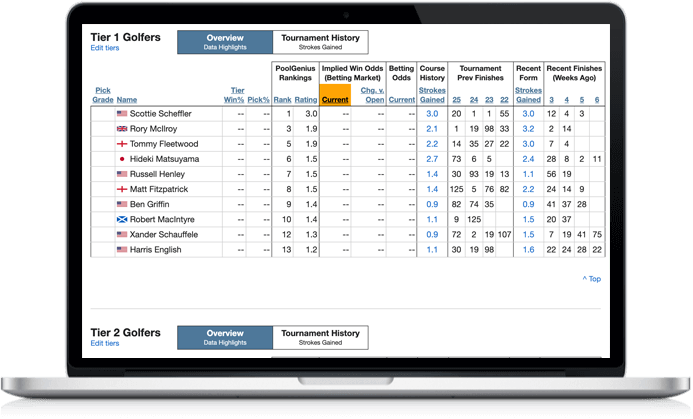
The PoolGenius Masters & Majors Tool lets you input your exact tiers and scoring settings, then builds a customized dashboard for your pool.
It pulls in pick popularity from major pool hosting sites and lines it up against:
- Market odds
- Course history
- Strokes gained data
- Recent form
So instead of guessing where to deviate from the field, you can actually see where the leverage spots are and pick your spots accordingly.
GET THE MASTERS PICKS TOOL
Plan Your Masters Pool Strategy →
Pool Picks Discounts Courtesy of VSiN →
Tier 1 Is Still the Most Important Decision
The most important decision you’ll make is in Tier 1.
At Augusta, the winner almost always comes from the top of the board. The last several winners have all been among the betting favorites, and over four rounds, elite players tend to separate from the rest.
So this isn’t the place to get overly creative.
You’re choosing between the top contenders, and the goal is to land on the golfer most likely to win the tournament. You can factor in popularity slightly, but forcing a contrarian play here usually creates more downside than it’s worth.
If you miss in Tier 1 and your golfer finishes well behind the top names in that group, it’s very difficult to make that ground back.
Middle Tiers: Where You Actually Gain an Edge
This is where the contest really opens up.
In the middle tiers, the gaps between players are much smaller. You’ll often have several golfers with similar odds and similar chances to make the cut.
But ownership won’t be spread evenly.
There will be a few popular options, and several comparable golfers who are used far less often.
That’s where the opportunity comes from.
You don’t need to go extreme, but it usually makes sense to avoid the most popular golfer in a tier when there are similar alternatives.
Because the edge shows up when things don’t break the way they seem on paper.
If a popular golfer in a middle tier misses the cut, a big portion of the field is suddenly using their dropped score there or taking a hit elsewhere.
If your golfer in that same tier makes the cut and posts a usable score, you’re not just gaining points. You’re staying flexible while other lineups aren’t.
Bottom Tier: Don’t Let One Pick Sink You
Most people shoot for the moon in the bottom tier. That somewhat makes sense when considering you drop the score of your worst golfer, but there’s a chance you may need that in an unexpected place across the top five tiers.
Because of that and the fact that this contest isn’t massive (223 entries), the final tier is less about upside and more about avoiding a bad outcome.
You’re dealing with a large group of longshots here, and the range of outcomes is wide. You don’t necessarily need to find a winner. You just need a golfer who won’t put you behind.
A good way to approach it:
- Look for golfers with stronger make-the-cut odds within the tier
- Avoid the most obvious chalk if ownership gets concentrated
- Focus on players who can give you a steady score
There’s no need to force a risky, low-owned play here. A reasonable golfer with low-to-moderate ownership is enough to keep you in position. It also gives you a foundation to reach for differentiated (but targeted) upside in those middle tiers.
How Unique Do You Actually Need to Be?
This format makes people think they need to get overly contrarian. They don’t.
With six golfers and one dropped, you effectively have five scores that matter. Even modest differences in those five create enough uniqueness in a 223-entry contest.
So the goal isn’t to find the lowest-owned golfer in every tier.
It’s about avoiding the most heavily duplicated paths while still keeping your lineup strong enough to compete if things go as expected.
Make Smarter Masters Picks With the PoolGenius Tool
At this point, we’ve thrown a lot of strategy elements at you: odds, tiers, scoring rules, pick popularity, and combining all of that to make smarter Masters picks.
The PoolGenius Masters & Majors Tool brings all of that together to create a customized cheat sheet for your specific pool.
Just enter your pool setup, and it gives you a clear view of:
- Win probability based on odds and analytics
- Course history and recent form
- Pick popularity across the field
- Tier-by-tier value and leverage spots
It balances these items and highlights where the real opportunities are.
So instead of piecing it together yourself, you can focus on making the right decisions with the full picture in front of you.
If you’re serious about this contest or any Masters pool you’re playing, this is the easiest way to actually apply all of it.
GET THE MASTERS PICKS TOOL
Plan Your Masters Pool Strategy →
Pool Picks Discounts Courtesy of VSiN →

The post How To Win Your 2026 Masters Tier Pool Contest: Strategies and Advice appeared first on VSiN.


Leave A Comment