
The 126th edition of the U.S. Open takes place this week at Shinnecock Hills Golf Club, located in Southampton, N.Y., on the shoreline of the Hamptons. Shinnecock Hills will host the U.S. Open for the fifth time since 1986. Over the last four U.S. Opens held at this venue, only three players finished under par, so we should expect a very difficult test once again.
World No. 1 Scottie Scheffler (6-1) is double the price he was last year at Oakmont, but still the favorite. Scheffler is trying to do what 2011 U.S. Open champion Rory McIlroy (12-1) did last year at the Masters: complete the career Grand Slam. Scheffler turns the big 3-0 on Sunday, which is also Father’s Day, and Scottie just welcomed his second child a little over two months ago, so he fits all the storylines and narratives this week, even if his play is slightly down from his terrific year in 2025 when he ended up winning two major championships.
Jon Rahm (14-1), the 2021 U.S. Open champion, has four career top-10s in the U.S. Open, including a T-7 last year at Oakmont, and was T-2 last month at the PGA.
Xander Schauffele (18-1) has never finished outside the top 20 in nine career U.S. Opens.
Matt Fitzpatrick (20-1) was the 2022 U.S. Open champion and arrives this year in arguably the best form of his career with three victories in 2026 and nearly gained a fourth last week before settling for a runner-up at the RBC Canadian Open.
Cameron Young (22-1) has two victories in 2026 and had a close call earlier this year at the Masters before finishing T-3, and he was T-4 last year at Oakmont.
Last time the U.S. Open was played at Shinnecock Hills in 2018, Tommy Fleetwood (22-1) shot a 63 on Sunday but fell one stroke short of Brooks Koepka (35-1).
Ludvig Åberg (22-1) and 2020 and 2024 U.S. Open champion Bryson DeChambeau (28-1) round out the crop priced lower than 30-1.
Other former U.S. Open champions in the field include J.J. Spaun (55-1), last year’s winner at Oakmont, 2023 winner Wyndham Clark (40-1), 2019 winner Gary Woodland (125-1), 2016 winner Dustin Johnson (150-1), 2015 winner Jordan Spieth (70-1) and 2013 winner Justin Rose (50-1).
The Event
This is the 126th U.S. Open championship. The U.S. Open, which was first played in 1895, was not contested for two years (1917-1918) during World War I and for four years (1942-45) during World War II.
The youngest winner of the U.S. Open is 19-year-old John McDermott, who won in 1911; he is among nine players age 21 or younger who have won the U.S. Open.
The oldest winner is Hale Irwin, who was 45 and playing on a special exemption when he won his third U.S. Open title in 1990. Irwin also won in 1974 and 1979.
There are four four-time U.S. Open winners: Willie Anderson (1901, 1903, 1904, 1905), amateur Bob Jones (1923, 1926, 1929, 1930), Ben Hogan (1948, 1950, 1951, 1953) and Jack Nicklaus (1962, 1967, 1972, 1980).
Only six players have won the Masters and the U.S. Open in the same year: Craig Wood (1941), Ben Hogan (1951, 1953), Arnold Palmer (1960), Jack Nicklaus (1972), Tiger Woods (2002) and Jordan Spieth (2015).
Last year’s U.S. Open winner, J.J. Spaun, earned $4.3 million of a $21.5 million purse that was the highest of the four major championships.
This year’s U.S. Open winner will not only receive a similar check amount but also the following:
• A U.S. Open exemption for the next 10 years
• An invitation to the next five Masters tournaments
• An invitation to the next five British Opens, conducted by The R&A
• An invitation to the next five PGA Championships
• An invitation to the next five Players Championships
• Exempt status on the PGA Tour for five years
• Custody of the U.S. Open trophy for one year, Jack Nicklaus Medal and a replica trophy
The Field
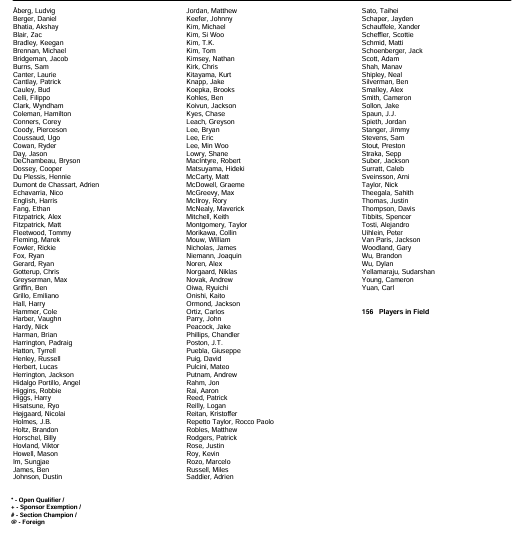
156 players are in this week’s field at the U.S. Open.
68 players in the field gained entry through final qualifying.
The weekend cut is the low 60 players and ties.
The Course
Shinnecock Hills Golf Club in Southampton, N.Y., was founded in 1891 and is recognized as the oldest incorporated golf club in the United States and was one of the five founding member clubs of the United States Golf Association. Just five years after opening, Shinnecock hosted both the U.S. Amateur and U.S. Open in 1896. The 2026 U.S. Open will mark the club’s 10th USGA championship and sixth U.S. Open. The club has also hosted the U.S. Women’s Amateur, U.S. Senior Amateur and the 1977 Walker Cup, while another U.S. Open is already scheduled for 2036.
The first major redesign was done by William Flynn in 1931, and the last one was done by the team of Bill Coore and Ben Crenshaw in 2016. That latest redesign expanded the fairways (48 yards wide on average) and restored the green edges to return the course to its original identity. Shinnecock Hills plays much like an American links course, firm and fast conditions, and wind rather than water hazards (just one water danger hole on the course) as its primary defenses.
Shinnecock Hills plays as a par-70 of 7,440 yards. The layout plays along and between various ridges. Many of the tee boxes are elevated, while many of the approach shots are in valleys, and players are hitting into elevated greens.
While the fairways are wide, it is not just “grip it and rip it” here because players have to hit smaller locations to get the best angles to the greens. Plus, there is the vintage U.S. Open rough, which will be fescue at 5 to 8 inches.
There are 160 bunkers, the most of any course this season, throughout the course.
The greens are predominantly Poa Annua with a little bit of Bentgrass. They average 7,500 square feet, so they will look large, but because they are elevated and have sharp contours, they will play smaller. The grasses around the greens are not the typical thick rough but instead are short grasses that will not hold errant approach shots. These greens are going to play a little slower than they did the last time the U.S. Open was here in 2018, and they will run at around 11.5 to 12 on the stimpmeter.
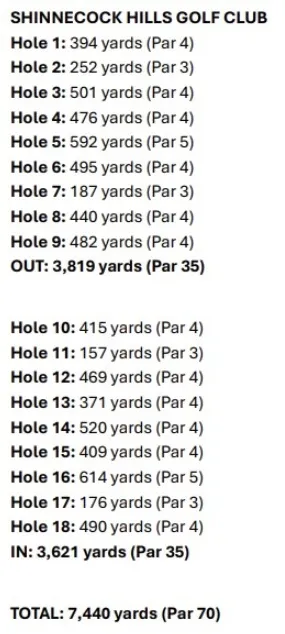
While the front nine is 200 yards longer, it historically plays a little easier as it is lower-elevated than the back nine. The back nine terrain is steeper with larger elevation changes and sharper contours.
In 2018, the scoring average across all four rounds that week was 74.65, +4.65 over par. This is a very difficult course. In fact, only three players have shot under par over four days in the last four U.S. Opens held at Shinnecock Hills.
Comparable courses to Shinnecock Hills include Pinehurst No. 2, Royal Troon, Pebble Beach, Kiawah Island, Winged Foot, Oakmont, Renaissance and TPC Sawgrass.
Golf Digest provides a hole-by-hole flyover video.
Weather
The Hamptons have not received much rain over the last three months, so conditions will be firm and the fairways will roll fast.
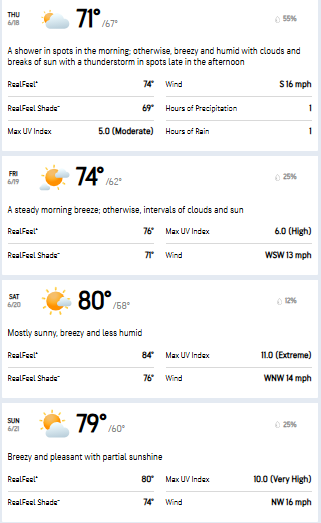
Both Thursday and Friday will see prevailing south-westerly gusts approaching 30 mph. The weekend looks calmer at 20-25 mph.
The AccuWeather forecast indicates wind should be at least somewhat of a factor throughout the championship.
U.S. Open Recent History
2025: J.J. Spaun (-1/279); Oakmont; 150-1
2024: Bryson DeChambeau (-6/274); Pinehurst No. 2; 20-1
2023: Wyndham Clark (-10/270); Los Angeles Country Club (North Course); 70-1
2022: Matt Fitzpatrick (-6/274); The Country Club (Brookline); 30-1
2021: Jon Rahm (-6/278); Torrey Pines (South Course); 10-1
2020: Bryson DeChambeau (-6/274); Winged Foot (West Course); 25-1
2019: Gary Woodland (-13/271); Pebble Beach; 80-1
2018: Brooks Koepka (+1/281); Shinnecock Hills; 25-1
2017: Brooks Koepka (-16/272); Erin Hills; 45-1
2016: Dustin Johnson (-4/276); Oakmont; 16-1
2015: Jordan Spieth (-5/275); Chambers Bay; 9-1
2014: Martin Kaymer (-9/271); Pinehurst No. 2; 40-1
2013: Justin Rose (+1/281); Merion (East Course); 28-1
2012: Webb Simpson (+1/281); Olympic Club (Lake Course); 80-1
2011: Rory McIlroy (-16/268); Congressional (Blue Course); 22-1
2010: Graeme McDowell (E/284); Pebble Beach; 80-1
U.S. Open Champions Lead In-Form
2025: Spaun (OWGR No. 25); 3 top-5s; 4 top-10s
2024: DeChambeau (No. 38): 2 top-5s, 5 top-10s
2023: Clark (No. 32); 1 win (Wells Fargo Championship), 3 top-5s, 4 top-10s
2022: Fitzpatrick (No. 18): 3 top-5s, 7 top-10s
2021: Rahm (No. 3): 3 top-5s, 7 top-10s
2020: DeChambeau (No. 9): 1 win (Rocket Mortgage Classic), 6 top-5s, 9 top-10s
2019: Woodland (No. 24): 1 top-5, 4 top-10s
2018: Koepka (No. 9): 1 top-5, 1 top-10*
2017: Koepka (No. 22): 1 top-5, 1 top-10s
2016: D. Johnson (No. 6): 5 top-5s, 7 top-10s
2015: Spieth (No. 2): 2 wins (Valspar, Masters), 7 top-5s, 9 top-10s
2014: Kaymer (No. 28): 1 win (Players), 1 top-5, 1 top-10
2013: Rose (No. 5): 3 top-5s, 5 top-10s
2012: Simpson (No. 13): 2 top-5s. 4 top-10s
2011: McIlroy (No. 7): 3 top-5s, 6 top-10s
2010: McDowell (No. 36): 1 win (Wales Open), 2 top-5s, 4 top-10s
* Koepka had missed the first four months of the 2018 season with injury.
U.S. Open Trends
- Every U.S. Open winner since 2008 had at least one top-10 in his previous five starts heading into the event and 15 of the last 18 had at least one top-5 in his previous five starts heading into the event.
- 16 of the last 18 U.S. Open winners made the cut in their previous major.
- 8 of the last 10 U.S. Open winners had at least a top-6 finish or better in a previous major.
- 14 of the last 18 U.S. Open winners had at least one top-10 previously at a major championship.
- 11 of the last 14 U.S. Open winners posted at least one top-15 finish in at least one of their two most recent starts leading into the U.S. Open.
- 10 of the last 14 U.S. Open winners have been Americans.
- 8 of the last 15 U.S. Open winners were ranked in the OWGR Top 15.
- 13 of the last 15 U.S. Open winners and 14 of the last 18 were ranked in the OWGR Top 30.
- 14 of the last 18 U.S. Open winners were between the ages of 26 and 32.
- 8 of the last 10 U.S. Open winners and 9 of the last 13 won their first major at the U.S. Open.
- The oldest winner of the U.S. Open since 2008 was Gary Woodland in 2019 at age 35.
Statistical Analysis
In the 2018 U.S. Open, the field hit over 70 percent of fairways yet managed to reach just 54 percent of greens in regulation despite being so large. Players have smaller targets than the 7,500 square feet greens would indicate because of the contours.
Strokes Gained: Approach — Average Per Round (Last 50 rounds)
- Ben Kohles 1.141 (21 rounds)
- Patrick Reed 0.917 (28 rounds)
- Jon Rahm 0.893
- Alex Fitzpatrick 0.853 (28 rounds)
- Cole Hammer 0.820 (19 rounds)
- James Nicholas 0.811 (19 rounds)
- Adam Scott 0.760
- Matt Fitzpatrick 0.748
- Sepp Straka 0.707
- J.J. Spaun 0.704
- Brooks Koepka 0.686
- Ludvig Åberg 0.681
- Collin Morikawa 0.675
- Ryan Gerard 0.658
- Cooper Dossey 0.637 (17 rounds)
- Scottie Scheffler 0.590
- Kurt Kitayama 0.585
- Rory McIlroy 0.583
- Viktor Hovland 0.574
- Tyrrell Hatton 0.568
- Shane Lowry 0.551
- Justin Rose 0.550
- Daniel Berger 0.543
- Jackson Suber 0.528 (35 rounds)
- Wyndham Clark 0.519
- Xander Schauffele 0.516
- Russell Henley 0.511
- Alex Smalley 0.509
The shots around the greens will be different than typical U.S. Opens with shorter grass and they will often be short pitches versus chip shots and chunking it out of thick stuff. Scrambling will obviously be difficult here once again.
Scrambling Percentage (Last 50 rounds)
- Alex Fitzpatrick 72.6% (28 rounds)
- Bryson DeChambeau 72.1
- Scottie Scheffler 70.3
- Tommy Fleetwood 69.5
- Russell Henley 69.0
- Cole Hammer 69.0 (19 rounds)
- Xander Schauffele 68.7
- Hideki Matsuyama 68.5
- Andrew Putnam 68.0
- Robert MacIntyre 68.0
- Min Woo Lee 67.6
- Kurt Kitayama 67.4
- Adrian Dumont de Chassart 67.1
- Cameron Young 67.1
- Si Woo Kim 66.9
- Davis Thompson 66.7
- Jake Knapp 66.7
- Matt Fitzpatrick 66.2
- Tom Kim 66.2
- Rickie Fowler 66.1
- Ludvig Åberg 65.9
- Jordan Spieth 65.4
- Maverick McNealy 65.3
- Adam Scott 65.3
- Ben Griffin 65.2
- Alex Smalley 65.2
- Adrien Saddier 65.2
- Jason Day 65.2
There is such a wide array of shots around these greens that will force players to be creative.
Strokes Gained: Around The Green — Average Per Round (Last 50 rounds)
- Cameron Smith 0.634
- Jason Day 0.578
- Padraig Harrington 0.551 (14 rounds)
- Andrew Putnam 0.544
- Scottie Scheffler 0.531
- Adrien Dumont de Chassart 0.518
- Matt Fitzpatrick 0.495
- Nathan Kimsey 0.489 (21 rounds)
- Justin Thomas 0.476
- Jon Rahm 0.473
- Brandon Wu 0.441 (21 rounds)
- Maverick McNealy 0.400
- Sungjae Im 0.397
- Miles Russell 0.393 (12 rounds)
- Patrick Cantlay 0.382
- Wyndham Clark 0.365
- Harry Hall 0.345
- Sahith Theegala 0.341
- Nick Taylor 0.336
- Ben Griffin 0.329
- Si Woo Kim 0.326
- Tommy Fleetwood 0.322
- Hideki Matsuyama 0.317
- Carl Yuan 0.306 (13 rounds)
Despite the wide fairways, driver was only used about 64% of the time at the 2018 U.S. Open because of the wind and the risk of deep rough if the fairways are missed.
Total Driving combines both Driving Distance and Driving Accuracy Rank.
Total Driving (2026 season)
- Min Woo Lee 44
- William Mouw 55
- Sudarshan Yellamaraju 56
- Collin Morikawa 57
- Michael Brennan 69
- Cameron Young 71
- Sam Stevens 72
- Matt Fitzpatrick 73
- Rory McIlroy 75
- Ludvig Åberg 82
- Daniel Berger 84
- Rickie Fowler 96
- Jake Knapp 100
- Johnny Keefer 101
- Scottie Scheffler 101
- Harris English 111
- Kurt Kitayama 113
- Corey Conners 117
- Ryan Gerard 117
- Ryo Hisatsune 122
- Si Woo Kim 123
- Keegan Bradley 123
- Wyndham Clark 125
- Xander Schauffele 128
- Tom Kim 130
- Tommy Fleetwood 131
- Adam Scott 132
- Jacob Bridgeman 132
Like any U.S. Open, bogeys and worse are plentiful. Pars are good scores on every hole here at Shinnecock Hills.
Bogey Avoidance Percentage (Last 50 rounds)
- Niklas Norgaard 8.3% (28 rounds)
- Jon Rahm 9.2
- Scottie Scheffler 9.8
- Peter Uihlein 10.1 (36 rounds)
- Bryson DeChambeau 10.9
- Russell Henley 11.4
- Alex Fitzpatrick 11.5 (28 rounds)
- David Puig 11.8
- Dustin Johnson 11.9
- Rory McIlroy 12.0
- Cameron Young 12.1
- Matt Fitzpatrick 12.2
- Lucas Herbert 12.2
- Graeme McDowell 12.3
- Tommy Fleetwood 12.5
- Adrien Dumont De Chassart 12.6
- Tom Kim 12.6
- Xander Schauffele 12.7
- Si Woo Kim 12.7
- Patrick Cantlay 12.7
- Caleb Surratt 12.8
- Kurt Kitayama 13.0
- Tyrrell Hatton 13.1
- Adam Scott 13.1
- Cole Hammer 13.2 (19 rounds)
- Alex Smalley 13.3
- Collin Morikawa 13.3
Note: Percentage that player makes bogey.
Shinnecock Hills had one of the highest three-putt rates in recent major championship history back in 2018. Players need to try and leave putts beneath the hole to have them uphill. Even if they are successful at doing so, they will have tough 6- to 8-footers for par at least a few times per round.
Three-Putt Avoidance (2026 season)
- Jacob Bridgeman 0.52%
- Jimmy Stanger 0.52
- Jake Knapp 1.07
- Sudarshan Yellamaraju 1.27
- Shane Lowry 1.29
- Rickie Fowler 1.39
- Nico Echavarria 1.44
- Nick Taylor 1.47
- Ryan Gerard 1.56
- Matt McCarty 1.63
- Chandler Phillips 1.67
- Adrien Saddier 1.71
- Nicolai Højgaard 1.79
- Sam Stevens 1.80
- Ryan Fox 1.85
- Scottie Scheffler 1.85
- Adrien Dumont de Chassart 1.91
- Billy Horschel 1.96
- Rory McIlroy 1.98
- Robert MacIntyre 2.00
Note: Percentage that player three-putts.
Lag putting is one of the most important skills for success in the U.S. Open. Players frequently face lengthy first putts across multiple ridges and plateaus and leaving it close for the second putt is largely going to determine who wins this championship.
Approach Putt Performance (2026 season)
- Alejandro Tosti 1′ 10″
- Patrick Cantlay 1′ 10″
- Tommy Fleetwood 1′ 11″
- Shane Lowry 1′ 11″
- Jimmy Stanger 1′ 11″
- Jordan Spieth 1′ 11″
- Corey Conners 2′ 0″
- Nico Echavarria 2′ 0″
- Si Woo Kim 2′ 0″
- Ludvig Åberg 2′ 0″
- Ben Griffin 2′ 0″
- Billy Horschel 2′ 0″
- Rickie Fowler 2′ 0″
- Adrien Dumont de Chassart 2′ 1″
- Nick Taylor 2′ 1″
- John Parry 2′ 1″
- Viktor Hovland 2′ 1″
- Alex Noren 2′ 1″
- Chris Gotterup 2′ 1″
- Collin Morikawa 2′ 1″
- Kurt Kitayama 2′ 1″
- Matt McCarty 2′ 1″
- Ryan Gerard 2′ 1″
- Sam Burns 2′ 1″
- Sam Stevens 2′ 1″
- Rory McIlroy 2′ 1″
Note: The average distance (in feet) to the hole after the first putt.
The par-4s provide the stiffest part of the course’s test. Six of them measure at least 490 yards, where players will have long approach shots, while four others play under 415 yards and emphasize positioning. Players will have to both show aggression and then be patient, and then be aggressive again, and then be patient again.
Strokes Gained Par-4s — Average Per Round (Last 50 rounds)
- Rory McIlroy 0.206
- David Puig 0.156
- Scottie Scheffler 0.145
- Cameron Young 0.138
- Alex Fitzpatrick 0.129 (28 rounds)
- Kurt Kitayama 0.115
- Akshay Bhatia 0.113
- Patrick Reed 0.112 (28 rounds)
- Joaquin Niemann 0.109
- Ludvig Åberg 0.105
- Harris English 0.102
- Xander Schauffele 0.101
- Tommy Fleetwood 0.100
- Gary Woodland 0.095
- Patrick Cantlay 0.094
- Nathan Kimsey 0.092 (21 rounds)
- Tyrrell Hatton 0.090
- Justin Rose 0.087
- Kristoffer Reitan 0.082
- Jacob Bridgeman 0.082
- Jake Knapp 0.077
Shinnecock Hills will be the most difficult course these players have to deal with all season. Patience and temperament will be vital to be in the mix come Sunday afternoon.
Strokes Gained Total: Hard Courses — Average Per Round (Last 50 rounds)
- Scottie Scheffler 2.683
- Justin Thomas 2.307
- Matt Fitzpatrick 2.084
- Tommy Fleetwood 1.876
- Dustin Johnson 1.755
- Sungjae Im 1.742
- Collin Morikawa 1.730
- Rory McIlroy 1.719
- Harris English 1.674
- Jordan Spieth 1.645
- Xander Schauffele 1.603
- Russell Henley 1.481
- Gary Woodland 1.457
- Jason Day 1.441
- Jon Rahm 1.382
- Tyrrell Hatton 1.367
- Brooks Koepka 1.349
- Chris Kirk 1.349
- Bryson DeChambeau 1.293
- Patrick Cantlay 1.264
- Patrick Reed 1.249
- Shane Lowry 1.225
- Patrick Rodgers 1.106
- Robert MacIntyre 1.105
- Billy Horschel 1.096
- Sam Burns 1.029
Selections
Tommy Fleetwood (+2250, DraftKings)
Embed from Getty ImagesFleetwood was runner-up here at Shinnecock Hills in 2018 as he shot a 63 on Sunday to finish one shot back of eventual winner Brooks Koepka.
Success on and around the greens will likely be the determining factor in who is victorious this week, and Fleetwood ranks fifth on the PGA Tour for both Strokes Gained: Around The Green and Scrambling.
Shinnecock Hills is an ideal course for Tommy Fleetwood as it is not too long, and it rewards positional driving and players who can play in windy conditions.
Matt Fitzpatrick (+2250, DraftKings)
Fitzpatrick is already a three-time winner on the PGA Tour this season and nearly won his fourth last week before finishing runner-up at the RBC Canadian Open.
The 2022 U.S. Open champion is fourth on the tour for both Strokes Gained: Approach and Greens In Regulation.
He was 12th here in 2018 and has always been a pedigreed player on links-type courses as a former winner of the Dunhill Links and with close calls at the Scottish Open and British Open.
Russell Henley (40-1, BetMGM)
Henley was the first-round leader here in 2018 before finishing 25th. At that point in his career, Henley was not much of a fixture in major championships, but now he has six top-10s in his last 14 dating to 2023, including consecutives in the U.S. Open.
He won two starts ago in the Charles Schwab Challenge at Colonial, gaining over eight strokes on Approach and leading the field for Strokes Gained: Tee-To-Green.
Henley is currently ranked fifth in the world and only the lack of a major championship keeps him from being truly recognized as one of the game’s best, and this week is a big chance for him.
Tyrrell Hatton (45-1, Fanatics)
Hatton was sixth last time here at Shinnecock Hills in 2018, and he is starting to inch closer and closer in major championships with a T-3 at the Masters earlier this year and a T-4 at Oakmont for last year’s U.S. Open.
The new father comes into this event off a victory last month at LIV Golf Andalucia, held at the famous Valderrama, which is another difficult course that relies on positional driving, control and precision. Plus, he held off Spaniard Jon Rahm on his home turf.
Hatton is a three-time winner of the Dunhill Links and should relish this course.
Sam Burns (45-1, Fanatics)
Burns has consecutive top-10 finishes at the U.S. Open and was the 54-hole leader last year at Oakmont before finishing T-7. He was also the first-round leader last week at the RBC Canadian Open and finished fourth at The Memorial two weeks ago.
Burns is always among the tour leaders for Strokes Gained: Putting, and this year is no exception as he ranks sixth.
While he can bomb it off the tee with the best of them, Burns will likely rely on more positional driving here and let his stellar short game take over.
Patrick Reed (55-1, Circa Sports)
Reed has not played a lot of golf lately. In fact, the last two events he played were both major championships. While it does not seem ideal to lack competitive preparation leading into a major, Reed finished T-12 at the Masters and T-10 at the PGA Championship.
He will be able to earn back his full playing status on the PGA Tour next year. In the meantime, he has played mostly on the DP World Tour and has won twice this season. In 2018, he finished fourth here, which was his best U.S. Open finish.
The 2018 Masters champion ranks top 12 in this field for Strokes Gained on Approach, Around The Green and Putting, which is the recipe to win here.
Placement markets, matchups and/or other bets will be available Wednesday at VSiN.com/picks.

The post U.S. Open Picks, Best Bets and Golf Odds appeared first on VSiN.


Leave A Comment